the live album in the world of rock tends to have, to say the least, an uncomfortable place. all too often the purpose of a live album tends to be a contract filler or a cheap cash in - see
Guns N Roses "Live Era" for clarification of this. very frequently it turns out the album, and here i am thinking of certain releases by the likes of The Rolling Stones and Simple Minds, has been "touched up" in the studio before release, robbing fans of the actual, unaltered sound supposedly captured.
some bands have over the years taken a vocal stance over the seemingly obligatory live release. Morrissey famously allowed a live album from The Smiths to be released on the sole condition that it was called
Rank, with the emphasis on rhyming slang. the Manic Street Preachers have vowed never to release one too, seeing them as a con.
every now and then, however, a live album captures what it is supposed to.
Frampton Comes Alive! is one of the best examples, a case of the live album sounding and selling better than any studio efforts from Peter Frampton. both The Stranglers'
Live (X Cert) and Bruce Springsteen's sprawling
Live 75 - 85 are evidence that live albums can be done properly every now and then.
and then, surpassing the three i have mentioned, there is
Live At Leeds by The Who.

the origins of the
Live At Leeds album are what you would expect of The Who. the band were rather satisfied with the American tour of
Tommy in 1969, to the extent that they felt a live document of it would be a worthy release. however, when confronted with hundreds of hours of recordings to go through, the band felt that it
might be easier just to go out and do a couple of shows, record them and release the best of them rather than spending weeks locked away pouring over the performances. thus some dates were arranged for February 1970, with Leeds and Hull being marked for recording.

it wasn't quite as simple as perform, take the recording and release it, however. there was a problem with John Entwhistle's bass powerline, which led to a static "click" appearing through most of the tracks. this saw most of the recordings, mindful of the limitations of producing equipment at the time, unusable. it did, however, lead to the infamous comment on the record about the clicks being OK...

...but still left the band with only a 6 track album to release, 3 of which were covers that they had never done studio versions of.
this isn't to say that the original album release (and first edition CD) was a loss, however. the six tracks you do get are the sound of The Who at full throttle, rarely sounding better. for all the debate around who started heavy metal (Cream? Led Zeppelin? Black Sabbath?) there's a case to say the way The Who tore up
Young Man Blues on this record gave birth to the rather harder sounding offshoot of rock.
as good as side one of the album is, side two is where you find the treasure. a 15 minute take on
My Generation, extended by some interesting bursts of their rock opera,
Tommy, is sheer menacing genius. a take on the song that you would think is impossible to follow up, in fact, if this wasn't The Who. whereas
Magic Bus in the studio was a quirky, close to novelty thing, on stage it becomes a devastating track, something that once heard you can't un-hear it and appreciate the studio version ever again. when compiling the soundtrack for
GoodFellas director Martin Scorsese insisted on using a segment specifically from this recording of the song on the soundtrack.

the design of the album was fascinating for an art-orientated band. after the elegance and extravagance of the
Tommy lp packaging, Pete Townshend seemed to go for a deliberate, low-key, almost bootleg look and feel to the album with it being released in a plain brown card cover with a stamp on the front to tell you what it was.
a different story on the inside, however, with some fascinating extras.

included in a pouch with the record (something my Dad still has) are things which surely made the purchase at the time worthwhile. you got copies of their invoice for playing Woodstock (where they famously and wisely insisted on being paid up front), a letter suggesting that the band "wasn't suitable" for a particular ballroom, a bill for damage done at one particular concert, and all sorts of other photographs and correspondence.
whereas this six track version was enough to establish the record in the list of "must own" albums for any serious rock fans, the 90s onwards saw more attention paid to it. following the magnificent
30 Years Of Maximum R & B box set of The Who released in the mid-90s, revamped and expanded versions of all their albums came about. the first expanded edition of
Live At Leeds was in itself a revelation.

yes, that's right,
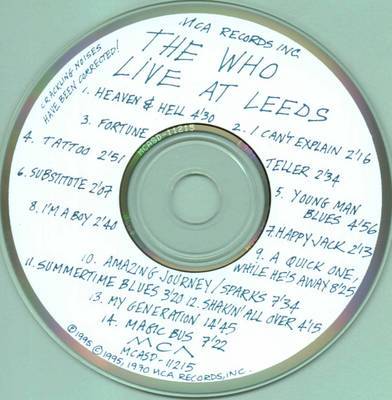
nine extra tracks featured on the re-release! apparently "mastering technology" had improved to such an extent that it was possible to address the static clicks which had left much of the Leeds recordings unusable. the band made sure you knew that, if you look at the CD face.

of the nine extra tracks, there are some fascinating revelations. regular opening track
Heaven And Hell is here in all its glory - listen away as three musicians and one vocalist battle away for the limelight from the start. the live reading of
A Quick One, While He's Away on this version is perhaps second only to the infamous
Rolling Stones Rock And Roll Circus recording in terms of the best captured performance of this mini-opera. in terms of their "proper opera",
Tommy, audiences were treated to a slice of the performance from Leeds here with the inclusion of
Amazing Journey and
Sparks.
through some oddity, there was not a proper, full "official" live recording of
Tommy available from the era, the closest you could get being the distinctly ho-hum 1989 revival album
Join Together. the performance from The Isle Of Wight Festival surfaced as a CD and DVD, but felt bland compared to the hints of
Tommy given on this expanded edition. these two excerpts made you wish for more, and indeed more was to follow with a third version of
Live At Leeds.

the "deluxe" version of
Live At Leeds gives you as full a performance of
Tommy as they gave at the time -
Sally Simpson was a rarity, and album tracks like
Cousin Kevin ,
Welcome and
Underture rarely, if ever, got played on stage. it is a superb record of the band peforming their creative masterpiece from the era when it was created. these days i am usually more inclined to play this version rather than the studio album of
Tommy, and believe me i hold the studio version in the highest possible esteem.
to make it an "easier" listening experience the set-list had been changed on this deluxe edition. it's not like The Who came out, did the hits and then did
Tommy as a finale or second act, as the order of these discs suggest.
Tommy was usually the centrepiece of their set, with a number of tracks before it and after it. how they found the stamina and energy to do over two solid hours of music night after night isn't all that much of a mystery considering their well documented off-stage habits, but remains something to behold and admire.
2010 saw a fourth and, hopefully for the sake of finances, possibly final version of
Live At Leeds being released. it should really be called the "everything you could possibly wish to hear" version.

in regards of the content, the first two discs are not all that different from the 2 CD "deluxe" version. some more dialogue from the band has been restored between songs, including it has to be said a very annoying explaination of
A Quick One by Pete that lasts nearly as long as the song itself!
the last two discs are the winner for this set. they feature, with a track listed shuffled like
Live At Leeds, the previously discarded
Live At Hull recording. it seems that Who fans in Hull didn't get to hear
Magic Bus, beyond that the tracklisting is the same as Leeds.
comparing the Hull and Leeds gigs is an interesting thing to do. performance-wise, there's very, very little difference - except to state quite clearly that the recording of
My Generation from Hull features possibly the greatest ever performance of this song by Roger Daltrey that i have ever heard. all the technology in the world, however, seems unable to mask or fix the fact that the Hull gig, for whatever reason, is a noticably weaker recording than Leeds. just as well, really - as many good friends as i have in or from Hull, well,
Live At Hull just doesn't sound as legendary rock and roll as
Live At Leeds, does it?
believe it or not, four different versions of the album is not quite where the
Live At Leeds story ends. the recent, brilliant documentary on The Who,
Amazing Journey, revealed actual footage from this celebrated gig.

whether or not there is enough quality footage from the gig entire to justify a DVD release remains to be seen. i certainly haven't even seen a bootleg of the footage floating around, so it remains to be seen if whoever provided the snippets seen in the documentary has any more. beyond that, though, bar releasing yet another version only having the discs run exactly as the concert did, it could be that the album has, with a perhaps generous but for fans necessary four versions, been released as often as it is ever going to be.
so just how and why is
Live At Leeds so significant? beyond the comments made here, a lot of the reason this live album works so well and so many others fail lies in the methods of making music adopted by The Who. as Pete Townshend has observed in a number of interviews, most bands at the time were attempting to emulate the studio sound on stage - notably The Beatles, who subsequently just gave up on live performing as a result. it was different for The Who, as they sought to capture the dynamics, energy and spontaneity of a stage performance in the studio. this album stands out as an example of why Townshend, Daltrey, Moon and Entwhistle were right to try and do it that way round.
in researching this post, i discovered by chance that the English Heritage Association seem to hold the album in as much high esteem as i do. very few recording studios get "heritage" status awarded to them, let alone venues on the basis of one particular concert. the city of Leeds can boast such an honour!

it would be pretty safe to say that any rock band truly worth their salt has had this album cross their mind when they have booked a date to play a gig in the fine city of Leeds.
Live At Leeds sets a very, very high benchmark for what a live album should sound like, and it is a benchmark that so very few have been able to get near. i would argue that this album is as essential as their two greatest studio works,
Who's Next and
Tommy, and should belong in the record collection of every serious music fan.
if you haven't heard the album and seek it out after reading this, happy listening!
be excellent to each other!!!!!!!!!!!!!!!!!!!!!!!!!!!!!!!!!!!!!!!!